Last Updated on January 8, 2026
For years, medication for alcohol use has been commonly framed as a last resort, something reserved for people with severe dependence, or only after everything else has failed. But that narrative is starting to shift.
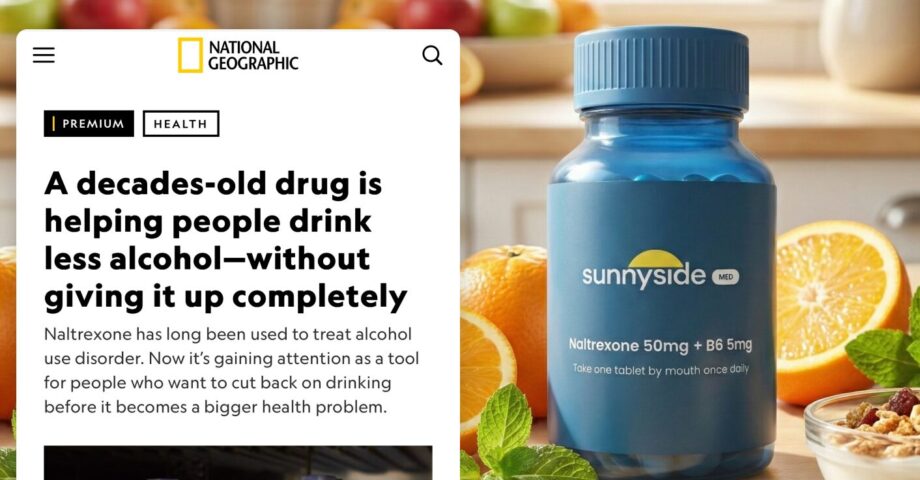
A recent National Geographic feature by Caitlin Carlson takes a closer look at naltrexone, a well-studied medication that can help reduce alcohol cravings for people who want to take a more mindful approach to drinking. Rather than positioning it as a drastic intervention, the article explores how naltrexone can be used proactively, alongside behavior change, to help people regain control before alcohol takes a heavier toll.

A Real Story of Change, Not Rock Bottom
At the center of the article is Kate, a Sunnyside user whose experience reflects a struggle that many of our community members face. Kate wasn’t hitting a dramatic rock bottom. She was functional, motivated, and increasingly uneasy about how much she was drinking.
Kate began with Sunnyside’s digital behavior-change program, building awareness around her habits and patterns. Later, she added naltrexone through Sunnyside Med. Over time, she reduced her drinking from roughly 28 drinks per week to a maximum of seven.
The numbers are compelling, but the story is also a big deal. As the article makes clear, medication alone wasn’t the answer for Kate — and neither was willpower by itself.
Kate credits her progress to a combination of tools: medication that reduced cravings and behavioral strategies that helped her make different choices once the noise quieted.
Why Access to Medication Has Lagged Behind
The article also highlights a broader issue in healthcare: Most people who could benefit from medication for alcohol use never get access to it.
Dr. Sarah Wakeman, the senior medical director for substance use disorder at Massachusetts General Hospital, Brigham, points out in the piece that medications like naltrexone are safe, well-studied, and underutilized. Traditional healthcare settings often wait until alcohol use becomes severe before offering medication, if they offer it at all.
Direct-to-consumer telehealth platforms, like Sunnyside Med, help close that gap by meeting people earlier in their journeys, when change is more manageable and less disruptive.
Just as importantly, Dr. Wakeman emphasizes that medication works best when paired with behavioral support, not as a standalone solution.
Medication Plus Behavior Change Works Differently
One of the strongest throughlines in the National Geographic piece is that naltrexone supports personal effort rather than just replacing it. By reducing the “reward” feeling that comes with drinking, naltrexone can make cravings less intense and less frequent. For many people, that can create space to pause, reflect, and use behavioral tools more effectively.
In Kate’s case, that meant continuing to track her drinking, identify patterns, and build alternatives — while no longer feeling like cravings were constantly pulling the strings.
This combination approach aligns with what research increasingly shows: biology and behavior aren’t competing explanations. They’re complementary.
“The Ozempic for Alcohol”?
Another expert featured in the article, Dr. Glenn-Milo Santos of UCSF Health, compares naltrexone to an appetite suppressant for alcohol, even calling it “the Ozempic for alcohol.”
While no analogy is perfect, the point lands: Naltrexone doesn’t force abstinence. It reduces cravings. And that makes it useful not just for people with severe alcohol dependence, but also for those who want to intervene before they reach that point.
Dr. Santos likens using naltrexone proactively to cutting back on sugar when you have prediabetes. “It’s sort of this paradigm shift that recognizes that cutting down heavy drinking is beneficial and addressing this issue before folks develop a severe alcohol use disorder is an important step in terms of interrupting that progression,” he says.
Catching Problems Earlier
Sunnyside cofounder Nick Allen is also quoted in the article, describing a trend Sunnyside sees every day: “As people become more aware of how alcohol affects sleep, mood, energy, and mental health, they’re paying attention earlier and looking for support before things feel like a real problem.”
Awareness is growing around how alcohol affects sleep, mood, energy, and mental health, and more people are questioning their relationship with drinking, even if their habits don’t necessarily look like other people’s idea of a “problem.” That earlier awareness opens the door to a lot of options, including medication paired with behavioral support, that can be employed before drinking becomes harder to change.
The main takeaway from the National Geographic article? There’s more than one way to change your relationship with alcohol, and sometimes a combination of a few strategies is your best bet for success.
You don’t have to wait for things to get worse to take your drinking seriously. Sometimes, the earlier the better. Get started on your mindful drinking journey with a 15-day free trial of Sunnyside.

What is Sunnyside?
Sunnyside is a mindful drinking and alcohol moderation app that can help change your habits around alcohol using a proven, science-backed method. Whether you want to become a more mindful drinker, drink less, or eventually quit drinking, Sunnyside can help you reach your goals. We take a positive, friendly approach to habit change, so you never feel judged or pressured to quit.
When you join Sunnyside, you’ll start by completing a 3-minute private assessment so we can learn a bit about you. Once that’s done, you’ll get a 15-day free trial to test out everything, including our daily habit change tools, tracking and analytics, community and coaching, and education and resources. It’s a full package designed specifically to adapt to your goals and help you reach them gradually, so you can make a huge impact on your health and well-being.
Sunnyside is a digital habit and behavior-change program that is incredibly effective on its own, but can also be the perfect complement to other work you’re doing to cut down on drinking, whether that includes talk therapy or medication such as Naltrexone.
Get your 15-day free trial of Sunnyside today, and start living your healthiest life.